Try a Free Demo and Then Buy VMware 3V0-21.25 Exam Dumps
Wiki Article
BTW, DOWNLOAD part of PassLeaderVCE 3V0-21.25 dumps from Cloud Storage: https://drive.google.com/open?id=1GUxlLH7QglYA_8lS44f7aAZcNhSAw-Qq
Every question from our 3V0-21.25 study materials is carefully elaborated and the content of our 3V0-21.25 exam questions involves the professional qualification certificate examination. We believe under the assistance of our 3V0-21.25 practice quiz, passing the exam and obtain related certificate are not out of reach. As long as you study our 3V0-21.25 training engine and followe it step by step, we believe you will achieve your dream easily.
VMware 3V0-21.25 Exam Syllabus Topics:
| Topic | Details |
|---|---|
| Topic 1 |
|
| Topic 2 |
|
| Topic 3 |
|
| Topic 4 |
|
| Topic 5 |
|
>> 3V0-21.25 Valid Study Questions <<
All Objectives for the Latest 3V0-21.25 Valid Study Questions
Maybe you are busy with working every day without the help of our 3V0-21.25 learning materials. The heavy work leaves you with no time to attend to study. It doesn't matter. Our 3V0-21.25 learning materials can help you squeeze your time out and allow you to improve your knowledge and skills while having work experience. And there are three versions of our 3V0-21.25 Exam Questions for you to choose according to your interests and hobbies.
VMware Advanced VMware Cloud Foundation 9.0 Automation Sample Questions (Q56-Q61):
NEW QUESTION # 56
Which statement describes Virtual Private Clouds (VPCs)?
- A. Enables multiple organizations to share the same physical Supervisor cluster while consuming logically isolated networks.
- B. Enables multiple organizations to share virtualized GPUs.
- C. Enables the provider administrator to create nested VCF instances with a private cloud.
- D. Enables the provider administrator to create multiple VCF instances nested within public clouds (e.g., Amazon AWS, Microsoft Azure, Google GCP, etc.).
Answer: A
Explanation:
Virtual Private Clouds (VPCs) in VCF 9.0 represent a significant evolution in multi-tenant networking. A VPC is a logically isolated network partition that exists within a shared physical infrastructure, specifically a Supervisor cluster. This construct allows multiple distinct organizations to coexist on the same compute hardware while maintaining complete separation of their network traffic, IP address spaces, and security policies. Each VPC acts as a "mini-datacenter" for the tenant, providing automated services such as routing, DHCP, NAT, and distributed firewalls without the tenant ever needing to see or interact with the underlying NSX Tier-0 or Tier-1 gateway architecture. This "abstraction" is the key to scaling VCF 9.0 deployments, as it allows the provider to maximize host utilization across many small tenants while giving each tenant the
"look and feel" of a dedicated, private networking environment. It effectively removes the complexity of manual VLAN or segment management that characterized older private cloud architectures.
NEW QUESTION # 57
An administrator has been tasked with creating a workflow in VCF Operations orchestrator. The workflow will be used to take a snapshot before planned maintenance work is carried out within the virtual machine, and then automatically remove the snapshot at the end of the maintenance window. The following information has been provided for the workflow:
. The workflow must allow a user to specify a virtual machine on which a snapshot should be taken.
. The workflow must take a snapshot of the virtual machine specified by the user.
. The workflow must name the snapshot based on the current date and time.
. The workflow must delete all snapshots on the virtual machine after a cooling off period of 5 days has elapsed.
. The workflow must stop running after the snapshot is created, a second workflow should automatically start when the 5 day cooling off period has elapsed.
The administrator creates a new workflow for this task and adds an input parameter to allow the user to specify the virtual machine.
Drag and drop the additional five steps the administrator should perform to continue configuring the workflow from the Possible Steps list on the left and place them into the Selected Steps list on the right in any order (Choose five.)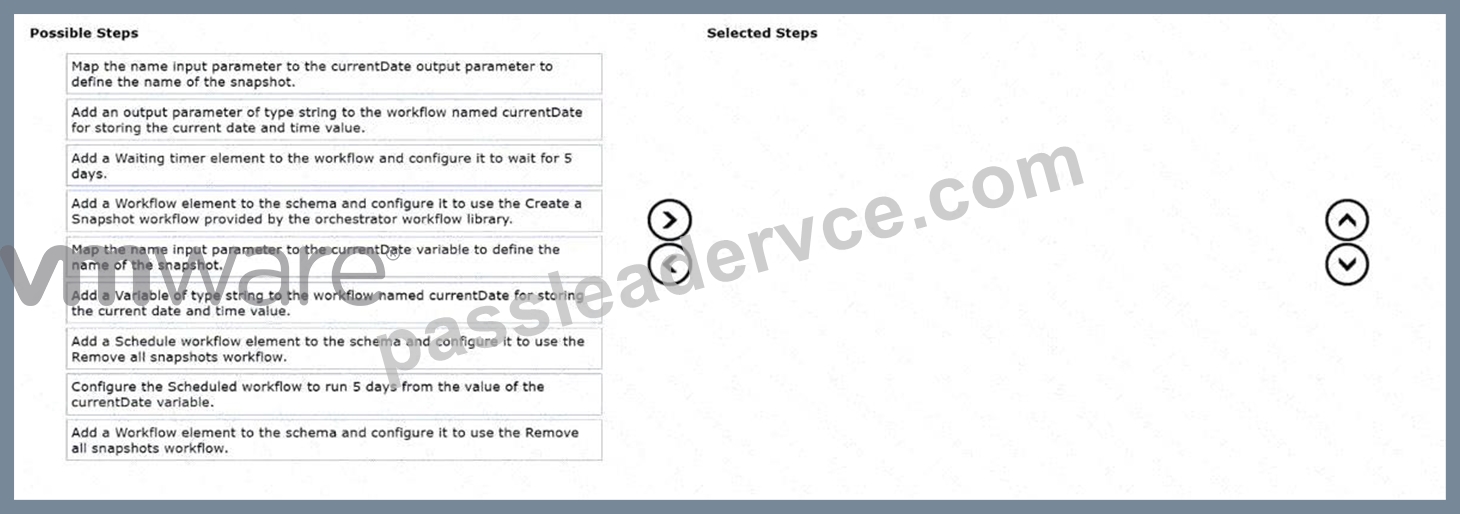
Answer:
Explanation: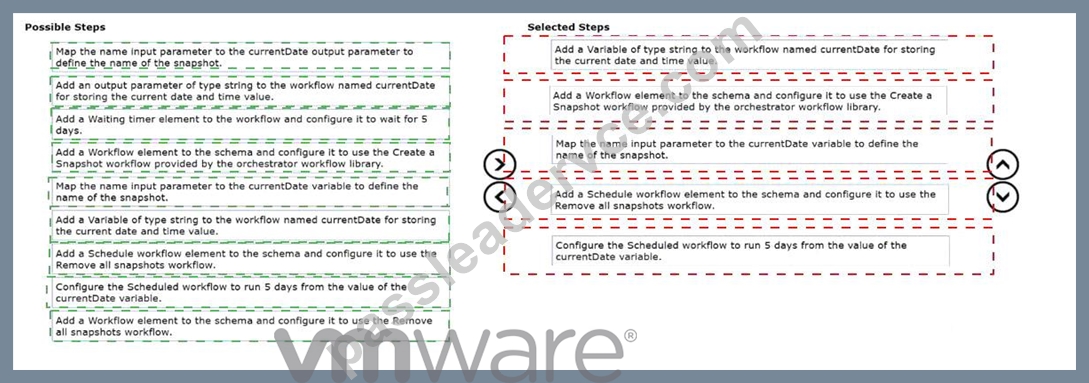
Explanation:
* Add a Variable of type string to the workflow named currentDate for storing the current date and time value.
* Add a Workflow element to the schema and configure it to use the Create a Snapshot workflow provided by the orchestrator workflow library.
* Map the name input parameter to the currentDate variable to define the name of the snapshot.
* Add a Schedule workflow element to the schema and configure it to use the Remove all snapshots workflow.
* Configure the Scheduled workflow to run 5 days from the value of the currentDate variable.
In VMware Cloud Foundation (VCF) 9.0, the Operations orchestrator (vRO) is used to build complex, state-aware automation. To satisfy the requirement that the main workflow stops running while a second cleanup task triggers later, the administrator must use the Schedule workflow element rather than a "Waiting Timer". A waiting timer keeps the workflow "Active," consuming system resources for the duration of the wait (5 days), whereas a scheduled task is handed off to the orchestrator's database to be triggered independently.
The configuration begins by defining a currentDate variable of type string. This variable captures the execution timestamp, which is then mapped to the Create a Snapshot library workflow to provide the required dynamic naming. To handle the automated cleanup, the administrator adds a Schedule workflow element. Unlike a standard workflow call, the scheduler allows for a specific execution offset.
By configuring the Remove all snapshots workflow to run 5 days from the currentDate value, the administrator ensures the snapshot exists for exactly the maintenance and cooling-off period before being programmatically removed. This approach is robust against orchestrator service restarts and provides a clean, asynchronous method for managing the temporary infrastructure lifecycle in a VCF
9.0 environment.
NEW QUESTION # 58
An organization is experiencing rapid growth, and the VMware Cloud Foundation (VCF) administrator needs to ensure that the "Development" organization does not consume all available physical resources in the
"West" region, which is shared with the "Production" organization.
What should the administrator configure to limit the total CPU and Memory consumption for the Development organization?
- A. Configure a Region Quota for the Development organization within the Provider Management Portal.
- B. Modify the Project constraints within the Development organization to include hard limits.
- C. Apply a vSphere Limit on the Supervisor clusters.
- D. Create a Resource Pool in vCenter and move all Development VMs into it.
Answer: A
Explanation:
In the multi-tenant architecture of VCF 9.0, Region Quotas are the primary administrative tool used by the provider to enforce resource governance. While vCenter resource pools (Option A) or vSphere limits (Option C) operate at a lower infrastructure layer, they do not integrate natively with the VCF Automation consumption model and can lead to unpredictable scheduling issues. By configuring a Region Quota within the Provider Management Portal, the administrator sets an upper bound on the total CPU, Memory, and Storage that a specific organization can request from the "West" region. When users in the Development organization attempt to deploy a new blueprint or scale an existing service, the automation engine checks the current consumption against this quota. If the request exceeds the limit, the deployment is blocked before it ever reaches the vCenter layer. This ensures that "noisy neighbors" cannot starve other mission-critical organizations-like Production-of essential capacity, allowing for fair and predictable resource sharing across the unified VCF 9.0 fleet.
NEW QUESTION # 59
A Provider administrator received a technical requirement mandating the use of Identity Providers (IdP) in place of local accounts. The following requirements were defined:
* The source directory service must be different between the Provider Management Portal and Organizations.
* The Organization administrators cannot modify the identity provider configuration.
What two requirements should the administrator configure? (Choose two.)
- A. Configure and publish a custom organization role for all organizations.
- B. Push the VCF Automation system LDAP service to all organizations.
- C. Setup custom LDAP service configuration per organization.
- D. Deploy an Identity Broker cluster per organization.
- E. Ensure that "Do not use LDAP" is configured for each organization's SSO.
Answer: D,E
Explanation:
VCF 9.0 Automation uses a decentralized identity architecture to support complex multi-tenant requirements.
To ensure that the Provider Management Portal and Organizations use different source directories (e.g., the provider uses a management AD while tenants use their own OIDC/SAML IdPs), the administrator must Deploy an Identity Broker cluster per organization. The Identity Broker acts as the localized gateway for authentication for that specific tenant. To prevent Organization administrators from modifying these settings- satisfying the second requirement-the provider must Ensure that "Do not use LDAP" is configured for the organization's standard SSO settings. This configuration forces the organization to rely exclusively on the broker-mediated IdP managed at the provider level, effectively "locking" the identity configuration and preventing local tenant admins from reverting to a manual LDAP setup that might bypass corporate security policies or the centralized identity strategy.
NEW QUESTION # 60
An administrator is deploying a Supervisor cluster in VMware Cloud Foundation (VCF) Automation and notices that only one vSphere zone is configured in the deployment workflow.
Which statement best describes the capabilities of the Supervisor cluster being deployed?
- A. The cluster will not have zone-level fault isolation.
- B. The cluster will automatically upgrade to multi-zone when additional zones are provided.
- C. The cluster will span multiple vSphere clusters for high availability.
- D. The cluster enables the use of a single control plane across multiple vCenter instances.
Answer: A
Explanation:
VCF 9.0 supports both Single-Zone and Multi-Zone Supervisor cluster deployments. In a single-zone deployment, all Supervisor control plane VMs and worker nodes reside within a single logical and physical fault domain (a single vSphere cluster). Consequently, the cluster will not have zone-level fault isolation. If the underlying hardware, power, or top-of-rack switch for that specific zone fails, the entire Supervisor instance and all hosted workloads (VMs and Pods) will go offline. Multi-zone clusters, by contrast, distribute nodes across three distinct zones to ensure that the control plane and workloads can survive the complete loss of one zone. While a single-zone cluster is suitable for non-critical development or testing, it represents a significant risk for production environments that require the high-availability and fault-tolerance features inherent to the VCF 9.0 multi-zone architecture.
NEW QUESTION # 61
......
Our approach to VMware 3V0-21.25 Exam Preparation is focused on quality over quantity, which means our VMware 3V0-21.25 practice tests help you identify the most important concepts and skills you need to master to pass the exam. We also provide ongoing 24/7 support to help you stay on track while using our product.
3V0-21.25 High Quality: https://www.passleadervce.com/VCAP-Automation/reliable-3V0-21.25-exam-learning-guide.html
- Reliable 3V0-21.25 Exam Prep ???? 3V0-21.25 Practice Exam ???? Latest 3V0-21.25 Study Plan ???? Search for “ 3V0-21.25 ” and obtain a free download on ▷ www.exam4labs.com ◁ ????3V0-21.25 Reliable Test Dumps
- 3V0-21.25 Online Training Materials ???? 3V0-21.25 Exam Simulator Free ???? 3V0-21.25 Pass4sure Study Materials ???? Copy URL ➤ www.pdfvce.com ⮘ open and search for “ 3V0-21.25 ” to download for free ????Valid 3V0-21.25 Exam Topics
- Desktop 3V0-21.25 Practice Exam Software ???? ➠ www.prepawayete.com ???? is best website to obtain ➽ 3V0-21.25 ???? for free download ????Exam 3V0-21.25 Preparation
- Get Use VMware 3V0-21.25 PDF Questions [2026] ???? ▷ www.pdfvce.com ◁ is best website to obtain [ 3V0-21.25 ] for free download ????Exam 3V0-21.25 Cram Review
- 3V0-21.25 Answers Real Questions ???? 3V0-21.25 Exam Overview ???? 3V0-21.25 Labs ???? Search for [ 3V0-21.25 ] and download exam materials for free through ➠ www.pass4test.com ???? ????Valid 3V0-21.25 Exam Answers
- Excellent 3V0-21.25 Valid Study Questions for Real Exam ???? Search for ➠ 3V0-21.25 ???? and download exam materials for free through ⇛ www.pdfvce.com ⇚ ????3V0-21.25 Reliable Test Dumps
- 3V0-21.25 Passing Score ???? Reliable 3V0-21.25 Dumps Free ???? Valid 3V0-21.25 Exam Topics ???? The page for free download of ⇛ 3V0-21.25 ⇚ on ⮆ www.troytecdumps.com ⮄ will open immediately ⛺3V0-21.25 Reliable Test Pattern
- High Hit-Rate 3V0-21.25 – 100% Free Valid Study Questions | 3V0-21.25 High Quality ???? Open website ➥ www.pdfvce.com ???? and search for 「 3V0-21.25 」 for free download ????3V0-21.25 Pass4sure Study Materials
- Desktop 3V0-21.25 Practice Exam Software ???? Open ⮆ www.pdfdumps.com ⮄ enter { 3V0-21.25 } and obtain a free download ↙3V0-21.25 Pass4sure Study Materials
- 3V0-21.25 Exam Dumps.zip ???? Exam 3V0-21.25 Preparation ???? 3V0-21.25 Exam Dumps.zip ???? Search on ☀ www.pdfvce.com ️☀️ for ( 3V0-21.25 ) to obtain exam materials for free download ????3V0-21.25 Exam Dumps.zip
- 2026 Unparalleled VMware 3V0-21.25 Valid Study Questions ???? Copy URL 「 www.verifieddumps.com 」 open and search for ✔ 3V0-21.25 ️✔️ to download for free ????3V0-21.25 Reliable Test Pattern
- lilyiudy620261.thebindingwiki.com, hylistings.com, directoryrelt.com, jesseoakz986030.vblogetin.com, dewanacademy.com, www.stes.tyc.edu.tw, www.stes.tyc.edu.tw, www.stes.tyc.edu.tw, www.stes.tyc.edu.tw, www.stes.tyc.edu.tw, Disposable vapes
P.S. Free 2026 VMware 3V0-21.25 dumps are available on Google Drive shared by PassLeaderVCE: https://drive.google.com/open?id=1GUxlLH7QglYA_8lS44f7aAZcNhSAw-Qq
Report this wiki page